
India and New Zealand have signed a landmark Free Trade Agreement (FTA) on April 27, 2026, hailed as a “once-in-a-generation” deal. The pact grants India duty-free access for over 8,000 export products, secures $20 billion in investment commitments from New Zealand, and opens new pathways for professional mobility with 5,000 visas annually.
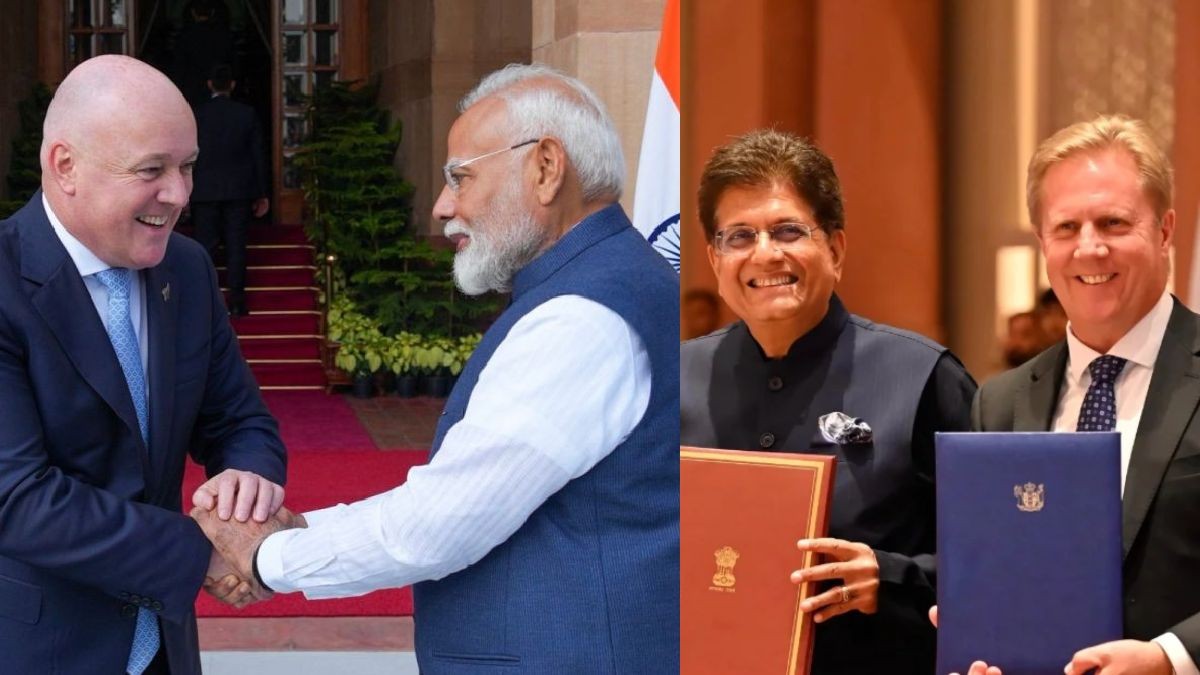
Major Update on the FTA
Signing Ceremony: Held in New Delhi in the presence of Commerce Minister Piyush Goyal and New Zealand’s Trade and Investment Minister Todd McClay.
Scope: The agreement spans 20 chapters, covering goods, services, rules of origin, customs facilitation, dispute settlement, and legal provisions.
Speed of Negotiation: Talks were revived in March 2025 and concluded by December 2025, making it one of India’s fastest-concluded FTAs.
Key Benefits of the Deal
For India
Duty-Free Access: Immediate 100% duty-free entry for 8,284 Indian export products into New Zealand, including textiles, apparel, leather, footwear, ceramics, and automobiles.
Professional Mobility: At least 5,000 visas annually for Indian professionals in skilled occupations, with stays up to three years.
Investment Boost: New Zealand has committed $20 billion in investments over 15 years, strengthening India’s manufacturing, food processing, digital technology, and clean energy sectors.
Job Creation: Expected to generate employment opportunities for farmers, MSMEs, artisans, startups, and youth.
For New Zealand
Market Access: Gains immediate access to over half its exports to India, including dairy, wine, and agricultural products.
Diversification: Helps New Zealand reduce reliance on traditional markets and expand into India’s 1.4 billion consumer base.
Export Growth: Supports New Zealand’s goal of doubling export value in 10 years.
Why the Deal Was Closed
Strategic Alignment: Both nations sought deeper economic ties after stalled negotiations in 2015. The revival in 2025 reflected mutual trust and urgency.
India’s Vision: The FTA aligns with PM Modi’s “Viksit Bharat 2047” vision, aiming to integrate India more closely with developed economies.
Global Gateway: India positioned itself as a gateway for New Zealand businesses to expand into Africa, Latin America, Central Asia, Europe, and the US.
Conclusion
The India–New Zealand FTA is a historic milestone that promises economic growth, job creation, and stronger bilateral ties. For India, it opens new export markets and investment flows, while for New Zealand, it diversifies trade and strengthens its global footprint. With ratification expected later in 2026, this agreement is set to reshape trade dynamics between the two nations.