
Iran has delivered a highly anticipated 10-point response to the United States’ earlier 15-point peace proposal, marking a critical moment in the ongoing conflict that has gripped West Asia for weeks. The response was reportedly conveyed through regional mediators, with Iran making it clear that it would not accept a temporary ceasefire alone and instead seeks long-term guarantees before agreeing to any settlement. The development comes as tensions continue to rise, with global markets and governments closely watching the situation due to the strategic importance of the Strait of Hormuz and the region’s energy supplies.
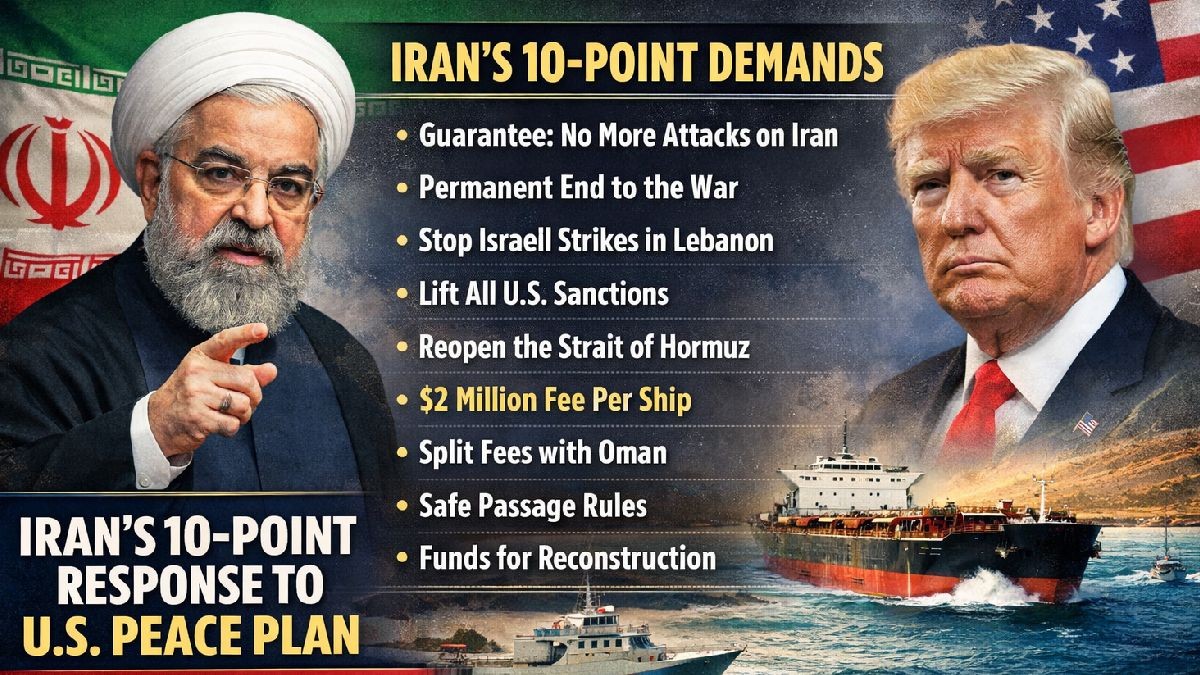
- 1. Guarantee that Iran will not be attacked again
- 2. Permanent end to the war, not just a ceasefire
- 3. End to Israeli strikes in Lebanon
- 4. Lifting of all US sanctions on Iran
- 5. End to all regional fighting against Iranian allies
- 6. In return, Iran would open the Strait of Hormuz
- 7. Iran would impose a Hormuz fee of $2 million per ship
- 8. Iran would split these fees with Oman
- 9. Iran to provide rules for safe passage through Hormuz 10. Iran to use Hormuz fees for reconstruction instead of reparations
According to details emerging from diplomatic sources, Iran’s 10-point plan outlines a set of strict conditions that it believes are necessary to restore stability. Among the key demands are guarantees that Iran will not face further military attacks, a permanent end to the war instead of a temporary ceasefire, and a halt to Israeli strikes in Lebanon and other regional operations involving Iranian-aligned groups. Tehran has also called for the lifting of all U.S. sanctions, arguing that economic restrictions must end if meaningful peace is to be achieved. These conditions reflect Iran’s broader stance that lasting peace requires structural changes rather than short-term arrangements.
In return for meeting these demands, Iran has reportedly offered to reopen the Strait of Hormuz, one of the world’s most critical oil shipping routes. The proposal includes plans to introduce regulated passage rules to ensure safety for commercial vessels and to collect transit fees from ships using the route. Iranian officials have indicated that revenue generated through these fees could be directed toward rebuilding infrastructure damaged during the conflict, signaling an attempt to link economic recovery with maritime security. The reopening of Hormuz remains a central issue, as disruptions there have already pushed global oil prices higher and triggered fears of wider economic fallout.
Meanwhile, U.S. President Donald Trump’s deadline for reaching a peace agreement is rapidly approaching, with only hours remaining before potential escalation. The U.S. administration has warned of severe consequences if negotiations fail, while Iran has responded that it will not yield to threats and insists on its own framework for peace. Diplomatic efforts are continuing behind closed doors, but uncertainty remains high as both sides weigh their next moves. With the deadline nearing, the world now waits to see whether the standoff will move toward negotiation or shift into a more dangerous phase of confrontation.