Gadkari Pushes States to Allow Bike Taxis
Union Road Transport and Highways Minister Nitin Gadkari has urged state governments across India to allow bike taxi services, arguing that the sector could create livelihood opportunities for around 8 crore people.
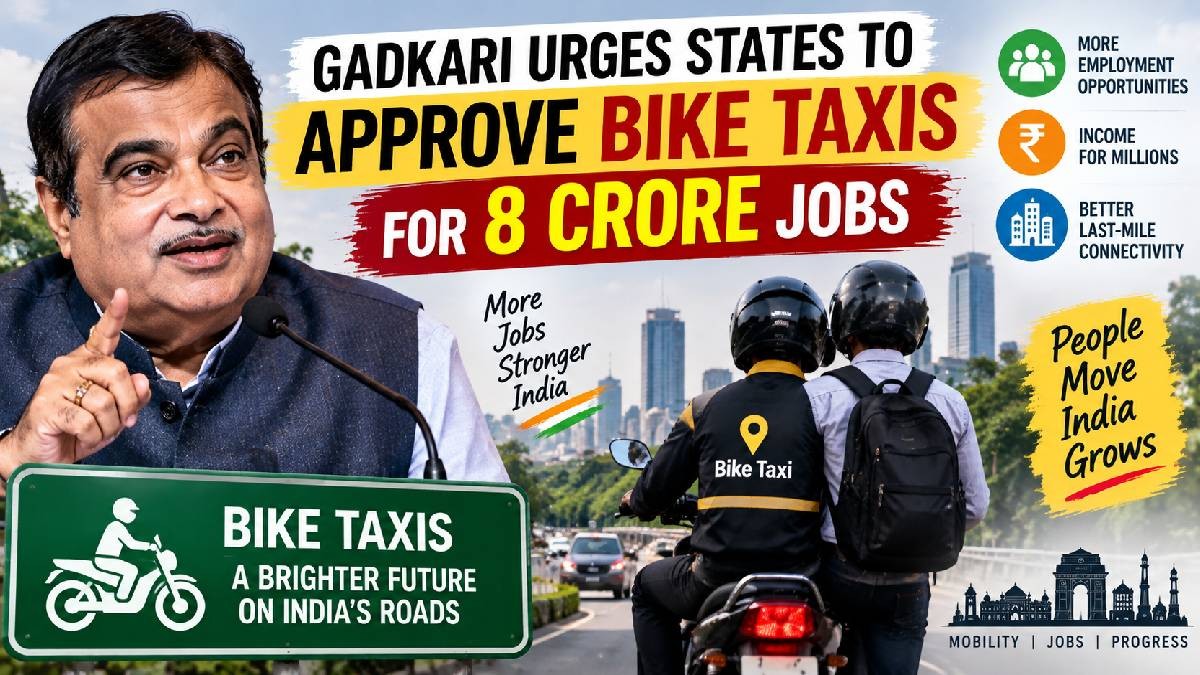
Speaking during the launch of the government's ‘Suraksha’ pilot programme, Gadkari said private two-wheeler owners should be allowed to use motorcycles and scooters to transport passengers. He pointed out that while the Centre has permitted such services within the applicable framework, some states have not yet allowed bike taxis.
Since transport is a state subject, the final decision on permitting and regulating bike taxis rests with individual state governments.
How Bike Taxis Could Create Jobs
Gadkari highlighted bike taxis as a potential source of income, particularly in rural and areas with limited employment opportunities. His estimate of 8 crore jobs represents the potential livelihood opportunities he believes the sector could generate if bike taxi services are expanded nationwide.
The proposal could also strengthen last-mile connectivity in cities and towns, where conventional public transport may not always provide convenient access. Two-wheelers can navigate congested roads more easily and potentially offer passengers a faster and relatively affordable travel option.
However, the 8-crore figure is an estimate of potential livelihood opportunities and should not be interpreted as a confirmed number of jobs that will be created.
States Will Have the Final Say
Despite the Centre's policy push, bike taxis are not automatically legal across India. State governments have the authority to decide whether and under what conditions such services can operate.
The Motor Vehicle Aggregator Guidelines, 2025 provide a framework under which states can permit aggregators to use non-transport motorcycles for passenger journeys. States can also prescribe additional conditions and fees.
This means the future of bike taxis could vary significantly from one state to another depending on local regulations, safety requirements and licensing rules.
Gadkari Also Announces Road-Safety Measures
Gadkari's bike-taxi comments came alongside a proposed negative-point system for traffic violations. Under the planned system, drivers would accumulate negative points for offences, with repeated violations potentially resulting in suspension or cancellation of driving licences.
The minister said the measure is intended to encourage more responsible driving and improve road safety.
He also launched the Suraksha pilot programme, which focuses on free medical diagnosis and counselling for drivers, construction workers and other high-risk workers. The initial pilot covers a 150-km stretch between Nagpur and Kamptee on NH-44 and the mining belt in Chandrapur, Maharashtra, with a target of 10,000 people.
What Happens Next?
Gadkari's appeal puts renewed focus on India's rapidly evolving bike-taxi economy. If more states approve private two-wheelers for passenger services, the sector could expand significantly and provide an additional income source for millions.
For now, however, state-level approval remains the key hurdle before Gadkari's vision of widespread bike taxis—and the potential 8-crore livelihood opportunity—can become reality.