
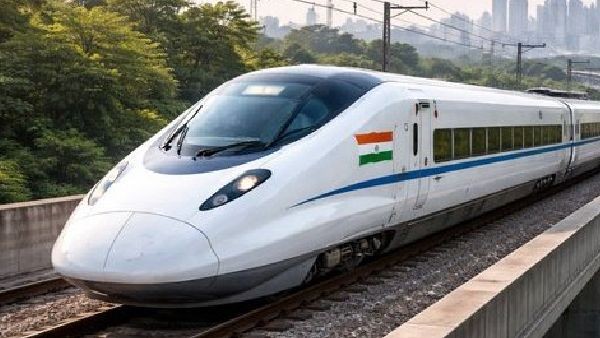
New Delhi: In a bold vision to transform the country's transportation landscape, Railway Minister Ashwini Vaishnaw has announced an ambitious roadmap for India's high-speed rail network. The government aims to develop 7,000 km of bullet train corridors by 2039-40, with a long-term target of 21,000 km, marking one of the most expansive rail infrastructure initiatives globally .
Seven New Corridors Approved
Prime Minister Narendra Modi has already approved seven new high-speed passenger corridors spanning approximately 4,000 km, with an estimated investment of Rs 16 lakh crore. These corridors, to be completed over the next 10 years, will connect key economic and industrial hubs across the country .
The approved corridors include the following routes:
Mumbai-Pune
Pune-Hyderabad
Hyderabad-Bengaluru
Hyderabad-Chennai
Chennai-Bengaluru
Delhi-Varanasi
Varanasi-Siliguri
These routes traverse metropolitan clusters, industrial belts, and fast-growing urban regions where inter-city travel demand is expected to grow significantly over the coming decades.
Indigenous Technology at the Forefront
The high-speed corridors are being designed for a maximum speed of 350 kmph, with a regular operating speed of 320 kmph. What distinguishes this initiative is its complete reliance on indigenous design, engineering, and manufacturing capabilities.
Vaishnaw emphasized that India successfully overcame the steep learning curve from the Mumbai-Ahmedabad High-Speed Rail Corridor, the country's first bullet train project. While Japanese partners initially estimated two km of construction per month, Indian engineers achieved 15 km per month, a feat that has drawn international interest for future collaborations .
Ambitious Annual Targets
To meet the 7,000 km target by 2039-40, Indian Railways will need to commission nearly 500 km of high-speed rail annually—effectively building a corridor equivalent to the Mumbai-Ahmedabad High-Speed Rail project every single year .
Plans are also underway to sanction an additional 3,000 km of high-speed corridors, which would bring the total envisioned network to 7,000 km by the target date, with a long-term projection extending to 15,000-21,000 km .
Financing Challenges Ahead
While the vision is expansive, experts point to significant financing challenges. The seven announced routes alone are estimated to require around Rs 16 lakh crore in investment. Indian Railways received record capital support in the Budget 2026-27, but even that may not fully address the financing needs for such an extensive network. Consequently, the Railway Ministry is actively examining public-private partnership (PPP) models to attract private investment.
Strategic Importance
These high-speed corridors are expected to serve trips ranging from 300 to 800 km, where bullet trains can compete with airlines on total travel time—not just line-haul speed. With India's airports increasingly congested and inter-city travel demand deepening, high-speed rail could produce significant economic gains through time savings and improved connectivity.
The initiative forms a crucial component of the government's Viksit Bharat Vision 2047, aiming to position India as a global leader in sustainable, high-speed mobility while reducing congestion on existing mixed-use tracks.