Mumbai is facing a growing long-term threat from rising sea levels, with a new United Nations report warning that the city is among South Asian urban centres increasingly vulnerable to permanent inundation, flooding and displacement.
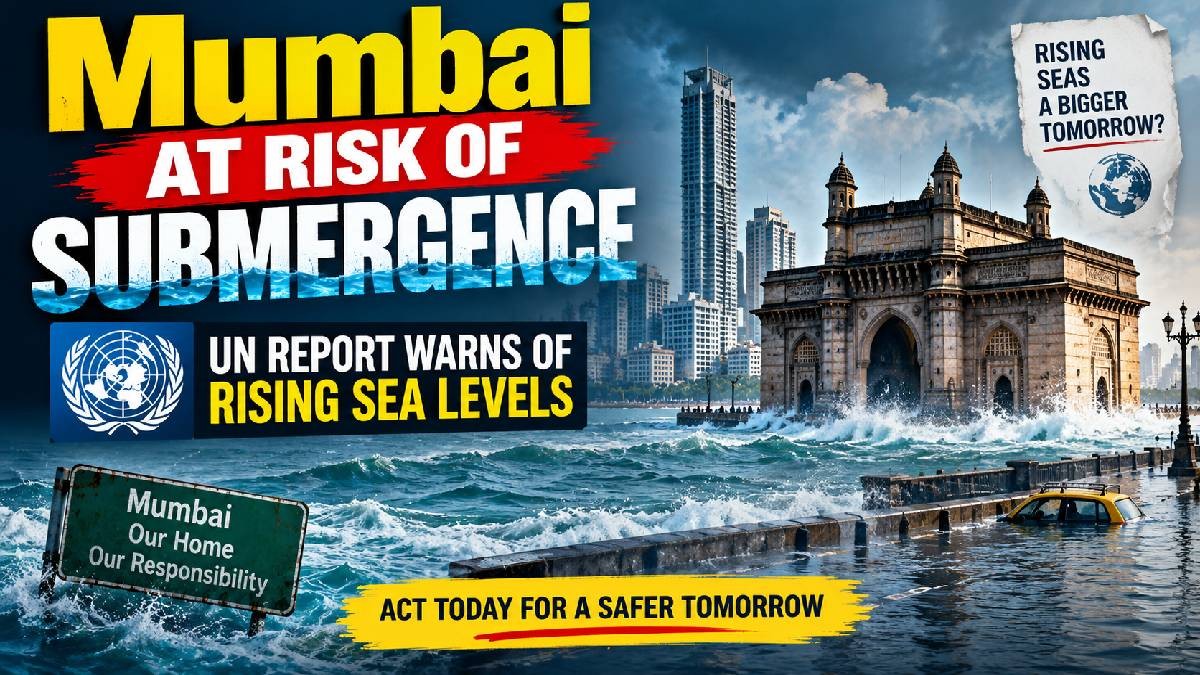
The UN Secretary-General’s report on “Challenges related to sea-level rise and ways and approaches to address it”, presented on August 31, highlights Mumbai and Kolkata in India, along with Dhaka in Bangladesh, as particularly vulnerable low-lying cities. The report warns that more than 14 million people across these areas are at immediate risk of losing their homes to permanent inundation.
Importantly, the 14-million figure applies collectively to the highlighted South Asian areas and does not represent the number of people at risk in Mumbai alone.
Why Is Mumbai Vulnerable?
Mumbai’s coastal geography makes it particularly exposed to the effects of rising seas. Large sections of the city are located along the Arabian Sea, while extensive areas of reclaimed and low-lying land are vulnerable to flooding.
The UN report also points to land subsidence, which can increase the local impact of rising sea levels. Saltwater intrusion is another concern because seawater entering freshwater sources can affect drinking-water supplies and groundwater ecosystems.
The risks extend beyond residential areas. Rising seas and storm surges could put additional pressure on Mumbai’s roads, rail networks, sanitation systems, housing, energy infrastructure and other essential services.
Sea Levels Rising Faster
The warning comes as global sea levels continue to rise at an accelerating pace. According to the UN, the average global sea-level rise reached 5.9 mm in 2024, compared with an average annual increase of about 4.7 mm during 2014–2023.
The Intergovernmental Panel on Climate Change (IPCC) projects continued sea-level rise through this century. Even under low-emissions scenarios, global mean sea level is expected to rise substantially by 2050, while higher-emissions scenarios could result in considerably greater increases by 2100.
Mumbai’s Flooding Risk
Mumbai already experiences severe flooding during intense monsoon rainfall. Rising sea levels could make the situation worse by reducing the ability of stormwater to drain efficiently into the sea.
A 2025 scientific study examining future coastal flooding across major Indian cities found that Mumbai and Kolkata face some of the highest projected flood risks, particularly under high-emission climate scenarios.
The UN has called for stronger coastal protection, improved early-warning systems, better climate data, resilient infrastructure and long-term adaptation planning.
The latest warning does not mean Mumbai will suddenly disappear underwater. Instead, it highlights a growing climate risk that requires decades of preparation and investment to protect residents, infrastructure and the city’s economy